About the Journal
Rodnoy Yazyk (“Mother Tongue”) journal was founded in Moscow in 2012. Its subject matter focuses on the linguistic structure and function of languages spoken in Russia and its neighbouring post-Soviet countries, including sociolinguistics, language policy, language contact, ethnolinguistics, grammatical analysis, lexicology and lexicography, language education, linguistic aspects of Bible translation, and the role of Bible translation in language maintenance and development work.
Current Issue
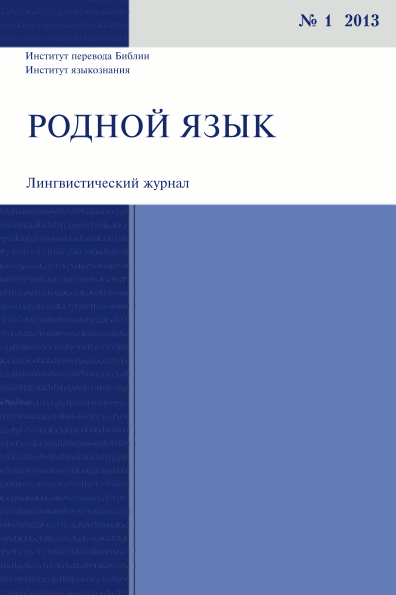
Dear Readers!
The journal “Mother Tongue” (“Rodnoy Yazyk”), which we are pleased to present to you, is a joint publication of the Institute of Linguistics of the Russian Academy of Sciences and the Institute for Bible Translation (Moscow). The launch of this journal is prompted by the need to draw the attention of researchers and readers to the status of the native language among the numerous peoples of the post-Soviet space. Recognizing the significance of one’s native language is a crucial factor in preserving both the language itself and the self-identity of a people—especially in an era of globalization and the catastrophic extinction of languages.
In any community, attitudes toward one’s native language are shaped at various levels of language use and at different stages of an individual’s development—within the family, at school, in state institutions, through writers’ unions, and via both spoken and written media. Scientific research—conducted not only from a synchronic perspective but also from a historical one—plays a vital role in supporting the status of a native language.
We hope that “Mother Tongue” will provide a platform to explore a wide range of linguistic issues and engage a broad spectrum of speakers of the many languages found across the post-Soviet space. Consequently, the journal will place special emphasis on the description and analysis of languages in this region that have only recently developed a writing system, as well as those that remain unwritten.
The journal will cover a diverse array of theoretical and practical questions related to the concept of a “mother tongue”. The conceptual framework for the journal is outlined in a programmatic article by M. E. Alekseev; it encompasses fields such as comparative-historical linguistics, typology, sociolinguistics, and the study of language contact—to name just a few of the linguistic disciplines directly relevant to the concept of a “mother tongue”. The first issue of the journal features articles by both prominent and emerging linguists across sections such as “Language and Society”, “Issues in Grammar”, and “Language Portrait”. These include contributions by M. E. Alekseev (on the necessity of incorporating unwritten languages into school curricula), S. M. Yaroshevich (on the structural characteristics of noun phrases in the Tabasaran language), M. Sh. Khalilova (on the Bezhta people and their language), and Yu. V. Psyanchina (on the role of the Bashkortostan Law on Languages in language instruction at a specific higher education institution).
A unique feature of the journal “Mother Tongue” (“Rodnoy Yazyk”) is that, alongside purely linguistic articles, it will regularly publish research on various aspects of translating the Bible into the languages of the post-Soviet region. In the sections “Linguistic Aspects of Bible Translation” and “Minority Languages and Bible Translation”, authors A. S. Desnitsky, A. B. Somov, and V. Yu. Voynov examine both the theoretical and practical dimensions of biblical translation. V. Yu. Voynov highlights grammatical and semantic features of minority languages that compel translators to grapple with questions regarding the meaning of the sacred text—questions that had not previously occurred to biblical scholars. A. B. Somov’s article explores specific biblical terms within the conceptual domain of the “afterlife”, discussing the challenges of interpreting and translating them into languages associated with traditional Buddhist cultures (Buryat, Kalmyk, and Tuvan), particularly in light of how these cultures conceive of the post-mortem state within the Buddhist tradition. Desnitsky offers not so much an analysis of theoretical issues concerning metaphor or the theory of biblical translation, but rather a series of examples drawn from the practical translation projects of the Institute for Bible Translation. All biblical citations are transliterated according to the guidelines set forth in “The SBL Handbook of Style for Ancient Near Eastern, Biblical, and Early Christian Studies” (Massachusetts, 1999).
The “Reviews” and “Chronicle” sections provide an overview of the most noteworthy publications and academic events.
The journal is conceived as an international publication. It will be issued in both Russian and English, with a frequency of two issues per year.
Alongside the print version, the journal will also be available in an electronic format on its own website: http://rodyaz.ru.